Teiji’s Photo Collection
The Earthquake BirdTeiji’s Photo Collection is the private photographic record through which Teiji observes and preserves his world, but it is also a boundary Lucy repeatedly tries to cross. Stored in boxes and withheld from her, the images give her fragments of Teiji’s history without making that history fully knowable. They draw Lucy into a rivalry with the people and memories the photographs preserve, and, after Lily’s death, images associated with Teiji acquire a different force: they become evidence that distinguishes what Lucy knows from what the police can prove.
Contents and Origins
Teiji keeps two boxes of photographs in his apartment, with envelopes and folders arranged in neat piles beneath their cardboard flaps. Lucy understands the boxes as a chronicle of his life, perhaps reaching back to his first camera. One box holds childhood photographs; another contains images from his years in Tokyo. The archive is extensive enough to suggest a life recorded across many stages, but its order and contents remain only partly available to Lucy. Her understanding depends on the limited images Teiji gives her, the scenes she glimpses without permission, and the stories she supplies to connect them.
Teiji’s photographic life began with a camera his father gave him for his first day of junior high school. As a boy growing up near Kagoshima, he carried it on bicycle journeys through the countryside and photographed Sakurajima from different angles. After his father died, Teiji moved to Tokyo with his mother; at seventeen he left high school to work full-time in his uncle’s noodle shop. Lucy knows these details partly through a story Teiji told her, and partly through her own reconstruction. When she later enters his apartment, she deliberately closes the childhood box without looking through it. She is not seeking a complete account of his past so much as the missing years before he met her.
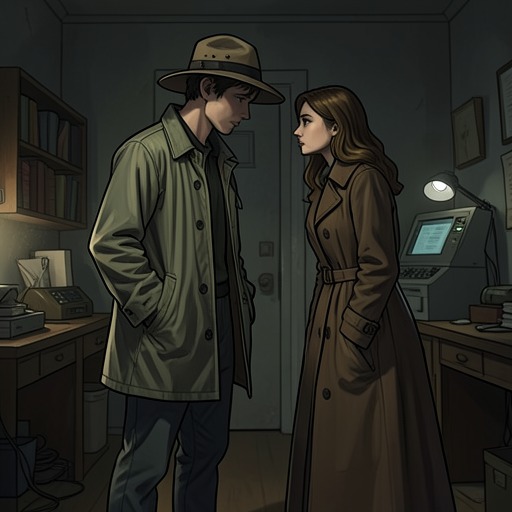
The collection’s Tokyo images include water, pavements, train stations, tunnels, and people. This range makes the archive more than a record of portraits: Teiji also photographs the city’s surfaces and passages. At their first encounter outside the Keio Plaza Hotel, Lucy steps into the puddle he is photographing. The reflected hotel divides into lit windows and darkness, with cigarette ends floating in the water. Teiji shifts around the puddle without lowering his camera, includes Lucy’s feet in the picture, then looks at her through the viewfinder and photographs her. Lucy never sees those first pictures. From the beginning, the camera both admits her into Teiji’s frame and keeps the resulting image under his control.
Lucy’s Access and the Discovery of Sachi
Teiji sometimes gives Lucy photographs containing her own image, but he does not show her the older contents of the boxes. After a conversation about what he might do with his pictures, Lucy is left wondering why he keeps so many images from her. Once Teiji leaves for his evening shift at the restaurant, she goes to his apartment, takes the spare key hidden in a crack beside the door, and lets herself in. She searches the Tokyo box, passing over the childhood pictures and the images from his arrival in the city to find the period before he met her.
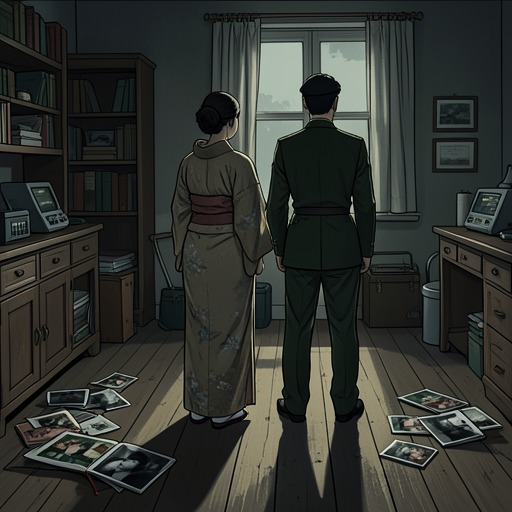
There she finds photographs of a young woman later identified as Sachi. In one, Sachi looks through a bus window with tired, angry eyes. Lucy follows the pictures backward to an early image of her onstage in a soldier’s uniform, alone beneath the theater lights, her mouth open in a silent shout. Moving forward through the collection, Lucy sees Sachi in theaters and in different costumes, then in coffee shops, parks, by a river, and at parties. The sequence changes in tone: Sachi appears less as an actress and more often among partygoers, looking progressively sadder, with crumpled and stained clothes. The last image Lucy sees shows her lying face-down on pavement, her mouth raised in an expression Lucy cannot distinguish as a grimace or a smile.
Teiji enters while Lucy is looking and tells her that the photographs are private. She is caught, but admits to herself that she regrets being discovered more than she regrets looking. The encounter makes the collection’s privacy concrete: what Lucy had treated as a secret she could uncover is, for Teiji, material he has expressly kept to himself. Lucy does not ask him about Sachi again. Instead, she imagines a history around the pictures, including a detailed account of Teiji’s devotion to Sachi’s performances and her decline into parties she could not bear. She later acknowledges that parts of this account may be invented; even the story of a man in the noodle shop who wept over theatrical performances may have no basis beyond a photograph of red, moist eyes. The images prompt interpretation, but do not certify the stories Lucy builds from them.
Images as Intimacy and Rivalry
Photographs of Lucy also shape how she understands her relationship with Teiji. She recalls waking after their first encounter and leaving her address beneath his camera, without a telephone number, hoping he would find her. A week later, when he comes to her apartment, she cannot remember what he said—or whether he said anything before they went to her room. Her recollection of the intimacy that followed is uncertain too: she imagines that afterward he may have wrapped her in a sheet and photographed her. In another remembered scene, Teiji lies beside her, takes a picture that includes his own image, and then whispers something. Lucy cannot recover his words. The photographs seem to offer a tangible record of closeness, while the circumstances and speech around them dissolve in uncertain memory.
When Teiji photographs Lucy and Lily together at the noodle shop, Lucy reads the image through possession rather than equality. Teiji gives the photograph to Lucy, carefully wrapped in folded newspaper. She pores over both sides of the paper for a message, though she knows the article about domestic abuse and the day’s exchange rates were not deliberately chosen for her. She is glad Teiji did not make a copy for Lily and privately treats the picture as an image of herself with Lily as an addition. She does not have it copied for Lily, although she knows Lily would have liked it. The photograph remains among the things Lucy cannot bring herself either to keep comfortably or to throw away.
Looking back, Lucy identifies the taking of that photograph—not simply the image it contains—as the beginning of trouble. The picture shows two women sitting at a table, but its making becomes, in her recollection, the instant when a hidden shift begins. Its significance arises from the act of photographing and the relations Lucy reads into who is included, who receives the image, and who is left out. That retrospective reading does not make the photograph itself proof of what followed; it reveals how Lucy turns the camera’s presence into a way of locating the start of a rupture.
Evidence, Limits, and Significance
After Lily disappears and Lucy is questioned, photographs connected to Teiji enter the case in a more consequential way. An envelope sent to the police contains two photographs. One shows Lily at a McDonald’s near Lucy’s home on the night of the murder, two hours after Lily was seen at Lucy’s front door. A cashier remembers Lily and a Japanese man having difficulty communicating and appearing distressed; Lily left her cheeseburger untouched but drank her Coke. The other image shows a woman confined within close brown walls, her head lolling and her eyes empty. The photographs supply details the police had not previously had, but they do not answer every question about what happened afterward.
Neither photograph bears fingerprints. The police do not know that Teiji took them, though Lucy recognizes his work. She also recognizes the limit of what they establish: the images do not prove that Teiji killed Lily. They do, however, show that Lucy was not the person with Lily at the McDonald’s two hours after Lily had visited her home, supporting the conclusion that Lucy’s brief venture outside that night was unrelated to Lily’s death. The case against Lucy is circumstantial, and the photographs help clarify that the evidence against her is not enough to charge her.
Lucy nevertheless turns the images into questions about Teiji. She wonders why he was waiting for Lily, whether Lily told him she wanted to be Lucy’s friend, and whether he believed losing Lily meant losing both women. She considers whether he killed Lily and whether photographing could be connected to keeping something for himself. But she stops short of treating suspicion as proof, noting that the evidence remains circumstantial and that she, of all people, should not judge too hastily. The archive’s significance lies partly in this gap between what a photograph makes visible and what it can establish: the images expose a meeting, suggest an unknown history, and help free Lucy, yet leave Teiji’s actions and motives unresolved.